
Understanding the Importance of a Marketing Plan
Definition of a Marketing Plan
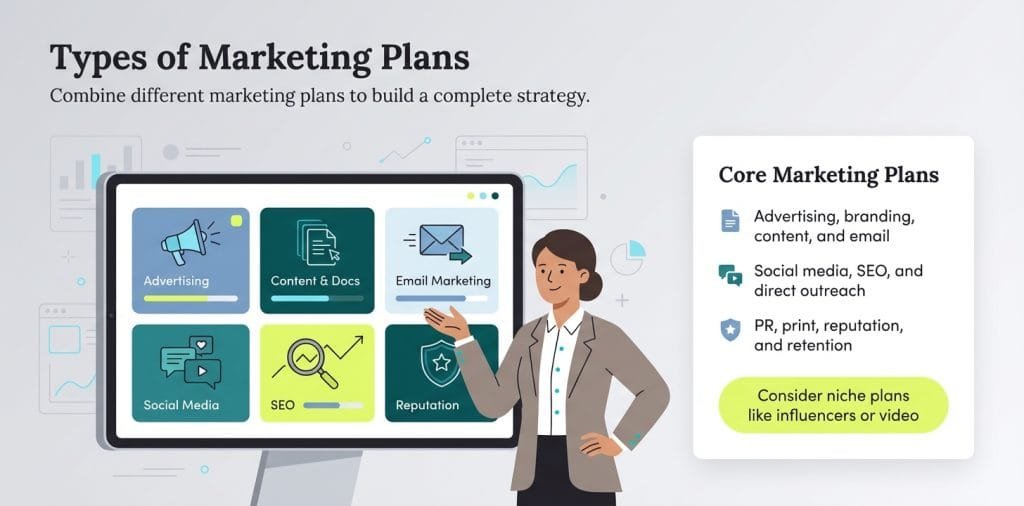
A marketing plan for small business is a strategic document that outlines your marketing goals, target audience, value proposition, and the specific tactics you will use to reach customers and drive revenue. Unlike a one-page checklist, a comprehensive small business marketing plan integrates market research, budgeting, channel selection, and performance metrics into a cohesive roadmap. The Hartford notes that effective marketing plans for small business align marketing activities with overall business objectives, ensuring that every dollar spent contributes to measurable growth. A business marketing plan should be a living document — updated regularly as market conditions, customer preferences, and competitive dynamics evolve. Whether you are building a marketing plan for a small business for the first time or refining an existing strategy, understanding what a marketing plan is and what it can accomplish is the essential first step.
Why Small Businesses Need Marketing Plans
Small businesses operate with limited resources — finite budgets, lean teams, and intense competition for customer attention. A well-designed marketing plan for small business ensures that those resources are deployed where they will generate the highest return. According to the U.S. Small Business Administration, businesses with documented marketing plans are significantly more likely to achieve their growth targets than those without. Marketing plans for small businesses provide direction, accountability, and a framework for measuring progress. The SBA's marketing and sales guide emphasizes that a clear small business marketing strategy helps owners prioritize activities, avoid costly mistakes, and respond quickly to market changes. Without a plan, marketing becomes reactive — chasing the latest trend rather than executing a deliberate strategy. For the entrepreneur asking "what marketing for my small business should I prioritize?", the answer begins with the plan.
Benefits of a Well-Structured Marketing Strategy
A structured marketing plan for small business delivers benefits across every dimension of the business. It clarifies your unique value proposition, ensuring that every campaign communicates a consistent message. It enables more accurate budgeting by aligning spending with strategic priorities rather than impulse decisions. According to Wolters Kluwer, a marketing plan component of your overall business plan is essential for securing financing, as lenders and investors want to see a thoughtful approach to customer acquisition. A well-structured small business marketing plan also improves team alignment — everyone from sales to product development understands what the marketing team is doing and why. For the solo entrepreneur, the marketing plan for small businesses serves as a decision-making framework that reduces uncertainty and increases confidence in resource allocation decisions.
Conducting Market Research for Small Businesses
Identifying Your Target Audience
Market research for small business begins with a clear definition of who you are trying to reach. Demographics — age, income, location, industry — provide the basic轮廓, but psychographics — values, pain points, aspirations — reveal what truly drives purchasing decisions. According to Salesforce, an effective small business marketing strategy starts with deep customer understanding, segmenting the market into distinct groups with shared characteristics and needs. Marketing plan for small business development should include the creation of detailed buyer personas that capture not just who your customers are, but why they buy, what they fear, and where they seek information. For B2B small business marketing strategy, target audience identification extends to company size, decision-maker roles, and purchasing processes. Social media marketing for small business efforts are significantly more effective when built on a foundation of precise audience targeting.
Analyzing Competitors and Market Trends
Understanding your competitive landscape is a critical component of any marketing plan for small business. Competitor analysis reveals what your rivals are doing well, where they are vulnerable, and what gaps exist in the market that your business can fill. According to Adobe's marketing plan examples, effective competitor analysis examines not just direct competitors but also substitute solutions and emerging entrants that could disrupt the market. Market research for small business should track both macroeconomic trends — shifts in consumer behavior, regulatory changes, technological developments — and industry-specific dynamics. BDC's guide on how to write a marketing plan emphasizes the importance of SWOT analysis — strengths, weaknesses, opportunities, and threats — as a framework for synthesizing competitive and market intelligence. Growth strategies for small businesses emerge naturally from a thorough understanding of where the market is heading and where competitors are focused.
Utilizing Tools for Market Research
Modern market research for small business is more accessible than ever thanks to a growing ecosystem of digital tools. Google Trends reveals search volume patterns for your keywords and categories. Social listening platforms like Brandwatch and Sprout Social track brand mentions, sentiment, and emerging conversations in your industry. Survey tools such as SurveyMonkey and Typeform enable direct customer feedback at minimal cost. According to business.com's marketing plan outline and template, secondary research — industry reports, government data, and academic studies — provides a cost-effective foundation for understanding market size and dynamics. Search engine optimization for small business tools like Ahrefs and Semrush reveal what keywords competitors are ranking for and where content gaps exist. For the budget-conscious entrepreneur, even free tools like Google Analytics and Google Business Profile provide rich data about customer behavior and preferences. Marketing analytics for small business transforms raw data into actionable insights that drive strategy refinement and resource allocation.
Key Components of a Small Business Marketing Plan
Executive Summary
The executive summary is the most important page of your marketing plan for small business. It distills the entire plan into a concise overview that executives, investors, and team members can read in minutes. A strong executive summary includes your business's mission and value proposition, target market summary, key marketing goals, core strategies, and financial highlights — budget overview and expected ROI. According to the SBA's marketing plan example, the executive summary should be written last but placed first, capturing the essence of the plan in a way that motivates readers to engage with the detailed sections that follow. For a marketing plan sample for small business, the executive summary serves as both introduction and sales document.
Market Analysis
The market analysis section demonstrates that you understand the environment in which your business operates. It includes industry overview — size, growth rate, and key trends; target market analysis — detailed profiles of your primary and secondary customer segments; competitive analysis — direct and indirect competitors with their strengths and weaknesses; and market positioning — how your business will differentiate itself. According to BDC's marketing plan guidance, a thorough market analysis answers three questions: where is the market heading, who else is serving it, and where is the opportunity for your business? Market research for small business findings are synthesized here, providing the factual foundation for the strategic decisions that follow.
Marketing Goals and Objectives
Clear, measurable goals transform a marketing plan for small business from a wish list into an actionable roadmap. Goals should follow the SMART framework — specific, measurable, achievable, relevant, and time-bound. Examples include increase website traffic by 40% within six months, generate 100 qualified leads per month through email marketing for small businesses, achieve a 5:1 ROI on paid advertising within the first quarter, grow social media following to 10,000 engaged users by year-end, and launch three new product lines with initial revenue of $50,000 each. Small business marketing plan goals should align directly with broader business objectives, ensuring that marketing is driving the outcomes that matter most to the organization.
Target Market Definition
A precise target market definition prevents wasted spending on audiences unlikely to convert. This section of your marketing plan for small business should include demographic details — age, gender, income, education, location for consumer markets or company size, industry, revenue for B2B markets; psychographic insights — values, interests, lifestyle, pain points; behavioral data — purchasing habits, brand loyalty, information sources; and customer journey mapping — how prospects discover, evaluate, and purchase solutions in your category. Branding for small businesses efforts are most effective when built on a deep understanding of the target audience's identity and aspirations. For advertising strategies for small business, knowing exactly who you are speaking to enables message precision that dramatically improves conversion rates.
Marketing Mix Strategies (4 Ps)
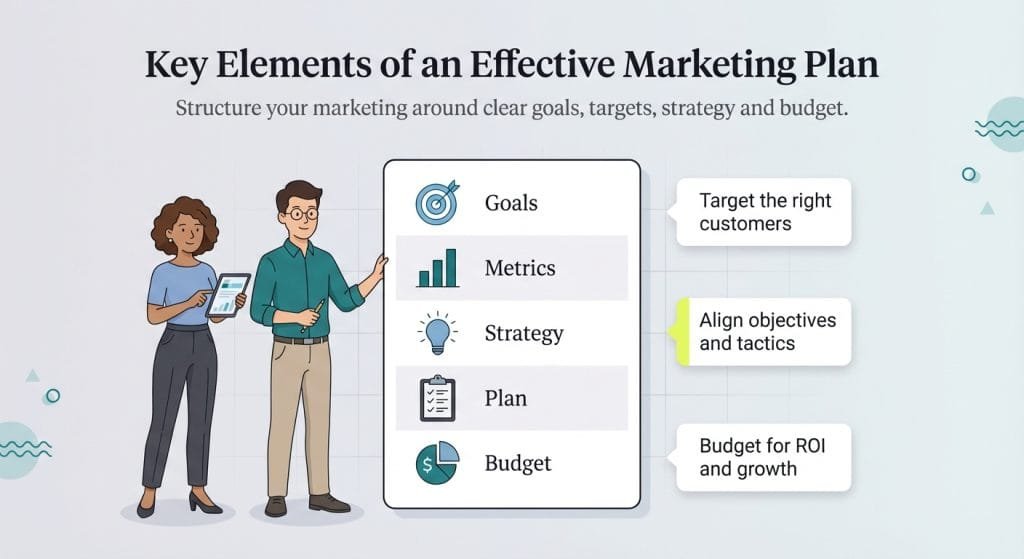
The 4 Ps framework — product, price, place, promotion — remains the cornerstone of any comprehensive marketing plan for small business. Product strategy defines what you are selling, including features, quality, branding, and packaging. Price strategy determines your pricing model — premium, competitive, or value-based — and how it positions you in the market. Place strategy covers distribution channels — online, retail, wholesale, direct sales — and how customers access your offering. Promotion strategy encompasses all the tactics you will use to reach and persuade your target audience: advertising, public relations, content marketing, social media, email, events, and more. According to Wolters Kluwer, the 4 Ps provide a structured framework for ensuring that every element of your marketing plan for small business is aligned and mutually reinforcing. Promotional strategies for small business should be selected based on where your target audience spends their attention and what messages will resonate.
Budgeting for Marketing Activities
A realistic budget is what separates a marketing plan for small business from a fantasy. The budget section should allocate resources across channels and activities, including projected costs for each tactic, expected ROI by channel, total marketing spend as a percentage of projected revenue, and contingency reserve for unexpected opportunities. According to business.com, small businesses should typically allocate 7–12% of revenue to marketing, though this varies by industry and growth stage. Digital marketing plan for small business budgets should account for both fixed costs — tools, subscriptions, salaries — and variable costs — ad spend, content production, event participation. For businesses exploring affordable marketing for small business options, the budget section should prioritize high-ROI activities like search engine optimization for small business and email marketing for small businesses over expensive experiments. Low budget marketing for small business requires creative approaches that maximize impact per dollar spent.
Digital Marketing Strategies for Small Businesses
Social Media Marketing for Small Business
Social media marketing for small business remains one of the most cost-effective channels for building brand awareness, engaging customers, and driving website traffic. The key is platform selection — rather than trying to maintain a presence everywhere, focus on the platforms where your target audience spends their time. LinkedIn dominates for B2B, Instagram and TikTok for visual consumer brands, Facebook for community building and local reach, and X (Twitter) for real-time engagement and thought leadership. According to APU's low-cost marketing strategies, consistent posting, authentic engagement, and strategic use of paid amplification can generate significant results even with minimal budget. Small business marketing strategy should include a content calendar that balances promotional, educational, and entertaining content. Customer retention strategies for small business benefit enormously from active social media engagement, which keeps your brand top-of-mind and fosters community.
SEO Strategies for Small Business Websites
Search engine optimization for small business is the foundation of sustainable organic growth. Unlike paid advertising, which stops generating results the moment you stop spending, SEO compounds over time — each optimized page continues to attract visitors months and years after publication. Key SEO strategies for small business websites include keyword research and targeting — identifying the terms your ideal customers are searching for; on-page optimization — title tags, meta descriptions, header structure, and content quality; technical SEO — site speed, mobile responsiveness, Core Web Vitals, and structured data; local SEO — Google Business Profile optimization, local citations, and review management; and link building — earning backlinks from reputable sources in your industry. According to Salesforce, organic search is the highest-converting channel for most small businesses, making SEO for small business a non-negotiable component of any digital marketing plan for small business. Internet marketing plan for small business strategies should prioritize SEO investment for its long-term compounding returns.
Email Marketing for Small Businesses
Email marketing for small businesses delivers the highest ROI of any digital channel — typically $36 for every $1 spent. It is the most direct, personal, and measurable way to communicate with your audience. Effective email marketing requires building a quality list through opt-in incentives, segmenting subscribers based on behavior and preferences, crafting compelling subject lines and body copy, automating key sequences — welcome series, abandoned cart, re-engagement campaigns, and testing and optimizing send times, content, and calls to action. According to the SBA, email marketing for small businesses is particularly valuable for nurturing leads through the consideration phase, delivering educational content that builds trust and positions your business as the obvious choice when the prospect is ready to buy. For small business marketing plan purposes, email should be treated as an owned asset — unlike social media algorithms, your email list is not subject to platform changes or policy shifts.
Online Advertising Strategies
Paid advertising accelerates results when organic strategies are not moving fast enough. Online advertising strategies for small businesses include Google Ads for intent-based search targeting; social media ads — Facebook, Instagram, LinkedIn, TikTok — for demographic and interest-based targeting; display advertising for retargeting and brand awareness; and native advertising for sponsored content on relevant publications. According to Adobe, successful advertising strategies for small business require clear campaign objectives, precise audience targeting, compelling creative, and rigorous tracking and optimization. Digital marketing plan for small business budgets should allocate paid advertising spend based on channel performance, scaling investment in channels that deliver the best ROI while reducing or eliminating spend on underperforming channels. Small business advertising requires constant testing — audience segments, ad formats, messaging, and landing pages — to identify winning combinations that can be scaled.
Influencer Marketing for Small Businesses
Influencer marketing for small businesses has grown from a niche tactic to a mainstream channel. Rather than pursuing celebrity influencers with million-follower counts, small businesses should focus on micro-influencers — creators with 1,000 to 100,000 engaged followers in a specific niche. Micro-influencers typically have higher engagement rates, more authentic relationships with their audiences, and significantly lower costs. According to business.com, effective influencer marketing for small businesses involves identifying creators whose values align with your brand, providing them with creative freedom rather than scripted content, and tracking performance through unique discount codes, affiliate links, or UTM parameters. Influencer marketing works particularly well for product-based businesses, local service providers, and brands targeting younger demographics who are increasingly skeptical of traditional advertising. Customer retention strategies for small business can also leverage influencers for loyalty programs, exclusive content, and community building.
Implementation and Measurement of the Marketing Plan
Action Plan and Timeline
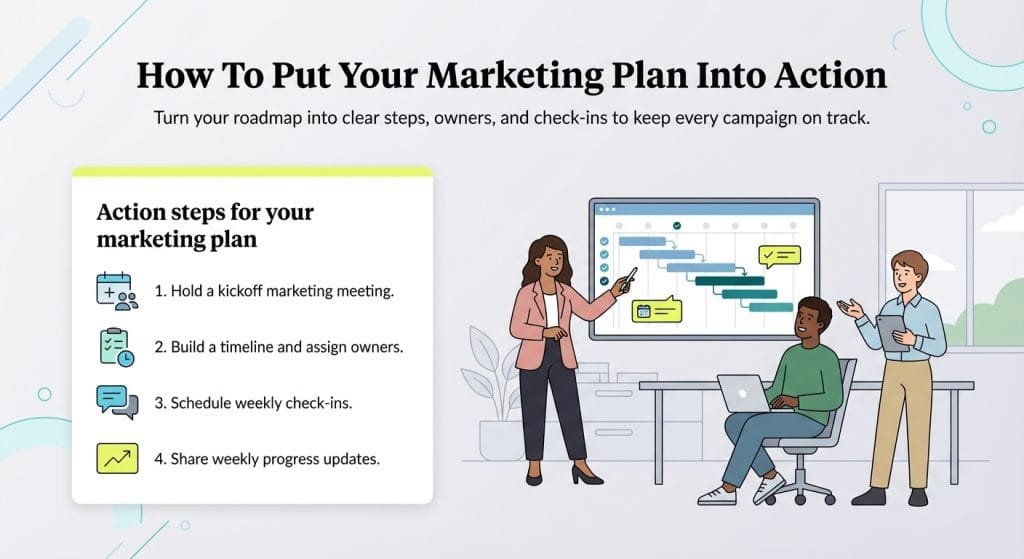
An action plan translates strategy into specific tasks with owners, deadlines, and dependencies. Your marketing plan for small business implementation timeline should include monthly themes — what major campaigns or initiatives occur each month; weekly tasks — recurring activities like content publication, social media posting, and email sends; milestone dates — product launches, events, campaign starts and ends; and review cadence — when the team will meet to review progress and adjust plans. According to BDC, breaking your marketing plan for small business into quarterly sprints makes the overall strategy more manageable and allows for course correction based on early results. Marketing plan template for small business tools like Asana, Trello, or Monday.com can help track progress and ensure accountability. The action plan should be detailed enough to guide daily activity but flexible enough to accommodate unexpected opportunities or challenges.
KPIs for Tracking Success
Key performance indicators transform your marketing plan for small business from a static document into a dynamic management tool. Essential KPIs for small business marketing include website traffic and traffic sources, conversion rate by channel, cost per lead and cost per acquisition, customer lifetime value and payback period, email open rate, click-through rate, and unsubscribe rate, social media engagement rate and follower growth, return on ad spend, and organic search rankings and visibility. According to the SBA's marketing plan example, KPIs should be reviewed at least monthly, with leading indicators — like email open rates and website traffic — providing early signals of future performance while lagging indicators — like revenue and customer count — confirm results. Marketing analytics for small business tools like Google Analytics, HubSpot, and SEMrush make KPI tracking accessible even for lean teams.
Adjusting Strategies Based on Marketing Analytics
The final — and most important — element of any marketing plan for small business is the commitment to continuous improvement based on data. Marketing analytics for small business reveals what is working, what is not, and where adjustments are needed. According to Salesforce, high-performing small businesses review their marketing analytics weekly, making tactical adjustments to campaigns and channels while evaluating strategic direction quarterly. Common adjustments include reallocating budget from underperforming to overperforming channels; refining audience targeting based on conversion data; testing new messaging, creative, or offers; and expanding successful campaigns while pausing or ending those that are not delivering. For affordable marketing for small business, analytics-driven optimization is the most powerful tool available — it ensures that every dollar is spent where it will generate the highest return. Low budget marketing for small business practitioners should be especially rigorous about measurement, since there is no room for wasted spend.
At STRATUMCATALYST, we help small businesses design and execute marketing plans that deliver measurable results. Whether you need a complete marketing plan for small business, digital marketing plan for small business guidance, or support with specific channels like social media marketing for small business or search engine optimization for small business, our team brings the expertise and experience to accelerate your growth. Contact us to start building your marketing plan today.